Who actually initiated this action? If something goes wrong, who can ultimately be accountable for?


Agent Governance
Grounded in Responsible AI, Alibaba proposes a set of principles for agentic AI governance and lives by them in our everyday operations, with a focus on strengthening identity, authorization, and accountability across agent ecosystems, helping to build the security infrastructure for the age of agents.
Alibaba has also brought this hands-on experience to the Internet Engineering Task Force (IETF)'s agent authorization standards work, co-developing the Deferred Token Response (DTR) specification with industry experts, now a Standards Track Internet-Draft adopted by the OAuth Working Group.
Security and Governance Challenges in the Era of Agents
As artificial intelligence is evolving from "generating content" to "performing tasks", AI agents can act on behalf of users, independently break down goals, select tools, invoke systems, and take action in real-world business environments. It brings new security challenges as well. We must consider:
Whom does the agent represent? What is authorized, and when does it expire?
Could the agent has excessive power and misuse permissions granted?
If other agents or tools are invoked, how the authorization propagated?
When something goes wrong, can the entire chain of accountability be traced back?
Could the accounts, tokens used by one agent be viewed or used by another agent?
Traditional security is designed primarily around "user logging into systems" and "applications accessing APIs." Instead, agents needs new security capabilities. Alibaba's answer is to build new security capabilities around independent identity, dynamic tokens, least-privilege authorization, delegation chains, audit evidence, and runtime isolation. Moreover, security capabilities at Alibaba are designed on a per-scenario basis together with corresponding security controls.
Six Core Design Principles for Agentic Systems at Alibaba
Independent Identity
Dynamic Tokens
Least-Privilege Authorization
Delegation Chains
Audit Evidence
Runtime Isolation
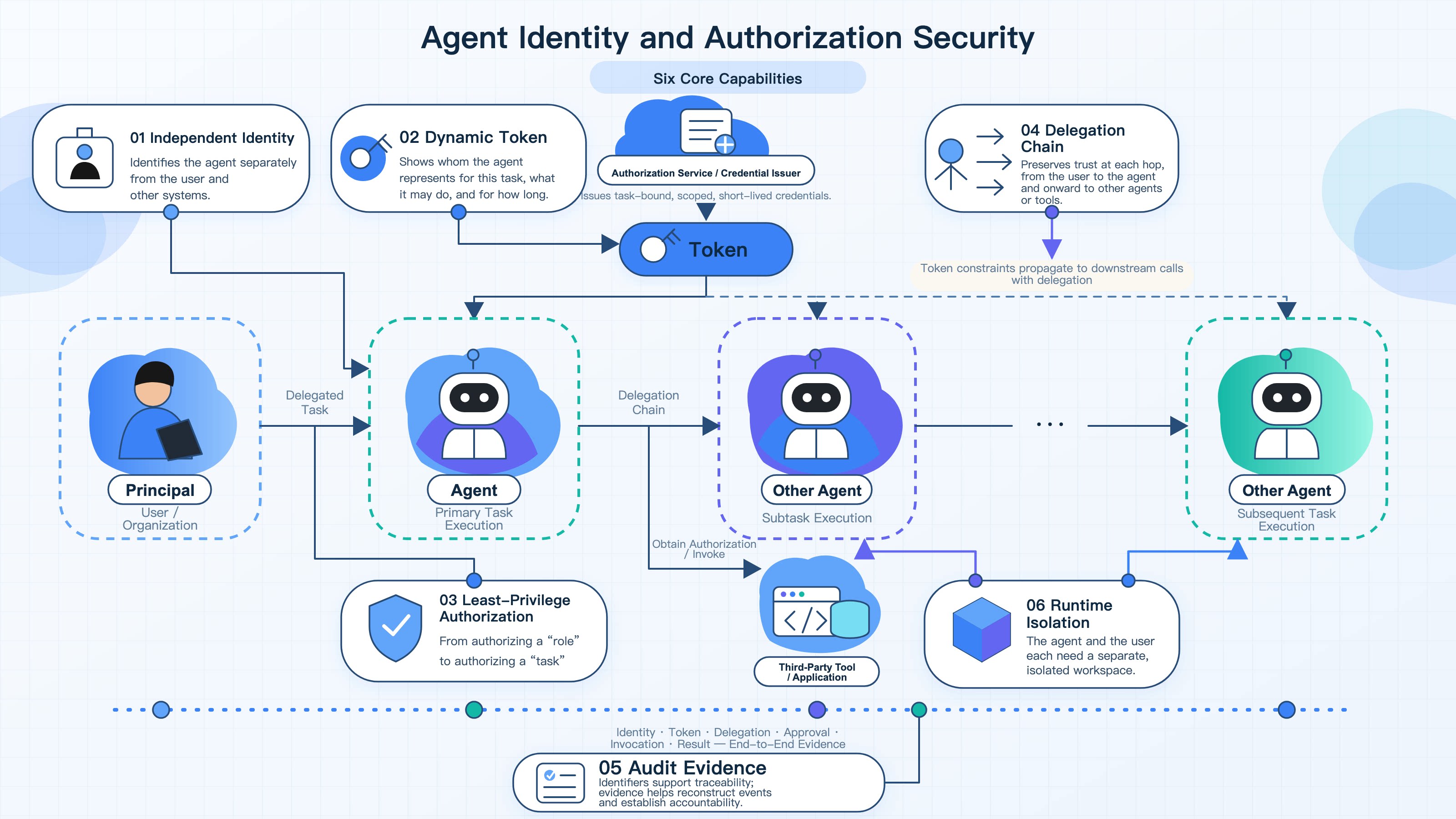
Independent Identity
Dynamic Tokens
Least-Privilege Authorization
Delegation Chains
Audit Evidence
Runtime Isolation
All Six Principles Are Essential
Scenario-aware authorization applies all six together
The six principles are not independent; they form one continuous chain, from task initiation, to authorization, to collaborative execution, to reconstructing accountability afterward. Risks differ by scenario, but every scenario must answer the same six questions: who is acting, whom they act for, what they may do, how authority is transferred and narrowed across delegation, how evidence is retained, and where the runtime boundary lies. Scenario-aware authorization ties them together: for each task, it works out the smallest identity and permission scope the agent needs, and no more.
Summary: Four Core Objectives
In our view, the key to agent security is not to require that the model never make a mistake, but to keep a mistake from easily crossing a boundary. A model may misread a task, pick the wrong tool, or be manipulated by malicious input. The identity and authorization layer should keep that from becoming a breach, so the agent cannot easily impersonate the user, gain permissions unrelated to the task, widen its authority during delegation, reach outside its runtime to read private data, or leave an unexplained gap in accountability. The four objectives are:
- Trustworthy boundaries: Independent identity and dynamic token keep authorization within the current scenario's boundaries.
- Constrained execution: Least-privilege access and runtime isolation hold the agent's authority within limits.
- Traceable processes: Audit evidence traces each action and supports accountability.
- Verifiable security: Scenario-based evaluation and red-team testing verify that these protections remain effective in practice.


